Reconstruction-era Requirement to Produce Proof of a Loyalty Oath
News of the WorldThe Reconstruction-era Requirement to Produce Proof of a Loyalty Oath turns Jefferson Kyle Kidd’s past into a matter of paperwork: while traveling on official business, he is told to produce a certified copy of his oath if he voluntarily aided the Confederate States Army. He has no such papers and denies having aided the Confederacy, in an encounter that reveals how documentary demands operated amid the political disorder of postwar Texas.
The demand for proof
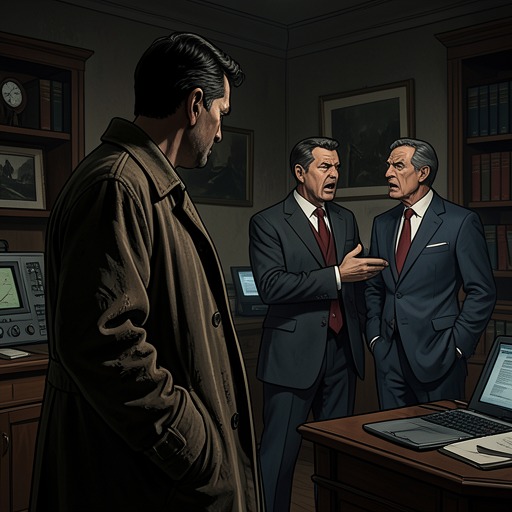
A lieutenant asks Jefferson Kyle Kidd whether he has his loyalty-oath papers. Kidd says he does not. The lieutenant explains that because Kidd is on official business, he will need a certified copy of the oath if he voluntarily assisted the Confederate States Army in any way. The condition is specific: the demand, as presented, attaches to voluntary aid, and the requested proof is not merely an assertion but a certified document.
Kidd answers that he did not aid the Confederacy. When the lieutenant asks whether his sons were involved in the conflict, Kidd says he has none. The exchange supplies no further evidence about the oath’s administration or what would happen if a traveler could not produce the required copy. In Kidd’s case, the lack of papers and his denial remain side by side; the scene does not resolve the discrepancy through documentary verification.
Enforcement amid political distrust
The demand appears in a setting where Kidd distrusts the Reconstruction government in Texas. He considers it corrupt and objects to the law against carrying handguns, even on the frontier. His remarks and his irritation with the soldiers make the encounter more than a neutral check of credentials: the oath requirement belongs to an official order he regards with hostility, while he still has to answer the lieutenant’s questions and account for his status.
The novel also shows how unstable official authority is elsewhere in Erath County. A group blocks entry to people who voted for Davis, and one of its members says there is no local administration, sheriff, justice of the peace, mayor, or commission. He attributes their removal to Davis’s men and the United States Army, says no replacements have been sent, and declares that the group has taken on the job and that travelers are accountable to it. This is a separate assertion of local power, not an enforcement of Kidd’s oath requirement; together, the episodes show official rules and practical authority operating unevenly.
Paperwork and precarious status
The oath exchange emphasizes the force a certified paper can carry: Kidd’s own account of his conduct does not meet the lieutenant’s stated documentary requirement if the condition applies. Elsewhere, the novel notes that Johanna has no adoption papers. That absence concerns a different matter and is not presented as part of the loyalty-oath demand, but it reinforces the distinction between lived relationships or experiences and their formal recognition in documents.
The requirement therefore functions less as a complete account of postwar legal procedure than as a concrete pressure within a fractured political landscape. The lieutenant specifies what Kidd needs to show; Kidd cannot show it and disputes the basis for needing it. Around them, other actors claim authority without the institutions that would ordinarily make its source or limits clear.